
At a dinner a few weeks ago, someone asked me, half-joking: "So what are you actually selling now that AI can write code?"
I laughed. Then I drove home and thought about it for a week.
The question deserves a real answer, because it's the question every CFO is quietly asking about every software vendor right now, and the honest version of the answer is more interesting than the defensive one. So here it is.
"Code is cheap"
It helps to start by noticing that the word cheap has two meanings.
Cheap means accessible. Democratization of software. Naturally you want the cheapest version of any product or service. Software is no exception. AI made code cheaper. Good for everyone. (Yes, I run a software studio. Yes, I am aware of how this sentence sounds. Bear with me.)
But cheap also means low-value. And that's the meaning the industry kept tripping over. The code itself was never where the value lived. It was always the thinking the engineers had when they wrote it. Architecture. Data modeling. Failure handling. Every little trade-off they made. Which things to build. Which things not to build.
The code was the receipt. The thinking was the work.
The shape inverted
We took an honest look at our delivery process and noticed the whole shape of it had inverted.
A six-month project used to be roughly 60–70% development. Writing the code itself. The other 30–40% was architecture, analysis, specification, design. And meetings. Real work, but often invisible to the client.
The code was the deliverable. The rest was the cost of producing that deliverable.
Now it's flipped. On AI-heavy projects (not every project is equally suitable), development is closer to 30% of the time. Agentic. AI writes most of the code. The other 70% is the thinking. And the thinking has stopped being invisible. The work that used to live behind the curtain is now the visible work. Typing got automated. Judgment, taste, and experience got promoted. Consulting in its purest form.
Last quarter we built a data management system for a healthcare client. An internal system, where you don't need to follow the design system and branding — ideal for an AI-heavy approach. The traditional timeline would be two months. We delivered it in three weeks. AI did most of the typing, our solution architect did all of the thinking.
So what does that look like in practice
Yes, AI changed how we work. We still build software. Just very, very differently. But here's the thing about software: the rules didn't change. You still need the same processes. User stories. Code reviews. Testing. Security.
AI will tell you everything you want to hear. "Wonderful idea." "Brilliant approach." "Such a smart way to frame the problem." It's the most agreeable colleague you've ever had, which is exactly what you want when you're brainstorming at 11pm and need the spark.
But it's also exactly what you don't want when you're about to spend three months and €100k on a digital platform. At that point you need someone who'll challenge the brief. Ask the question you forgot to ask. Point at the thing you skipped because it felt obvious. Explain why the obvious answer is wrong for your stage, your team, your customer. Someone who can turn a half-written doc into something concrete enough to actually build, and who'll occasionally tell you to put the doc away for a while.
Humans love humans
AI works with limited context. It cannot produce a system that fits your team, your budget, your stage, your regulator, and your three-year roadmap. It hasn't been in the meeting. It hasn't met your CFO. It doesn't know your last vendor burned you on a multi-tenant decision (real story).
We have. We sit in the meeting. We listen. We push back on the brief. We take the risk. Human judgment is what closes the gap between what AI knows and what your situation actually needs.
Humans love humans. Even when we don't admit it, we want to talk to real people. Clients are no different. They want a person who reads the room, sees their face when an idea isn't landing, whose judgment they can rely on.
I know what you're thinking. "I'm an introvert. I'd rather click a button than talk to anyone." Same. Me too. And yet, when production goes down at 4pm on a Friday, nobody wants to chat with a perfectly-trained LLM. You want a human voice. Even if it has bad news. Especially if it has bad news.
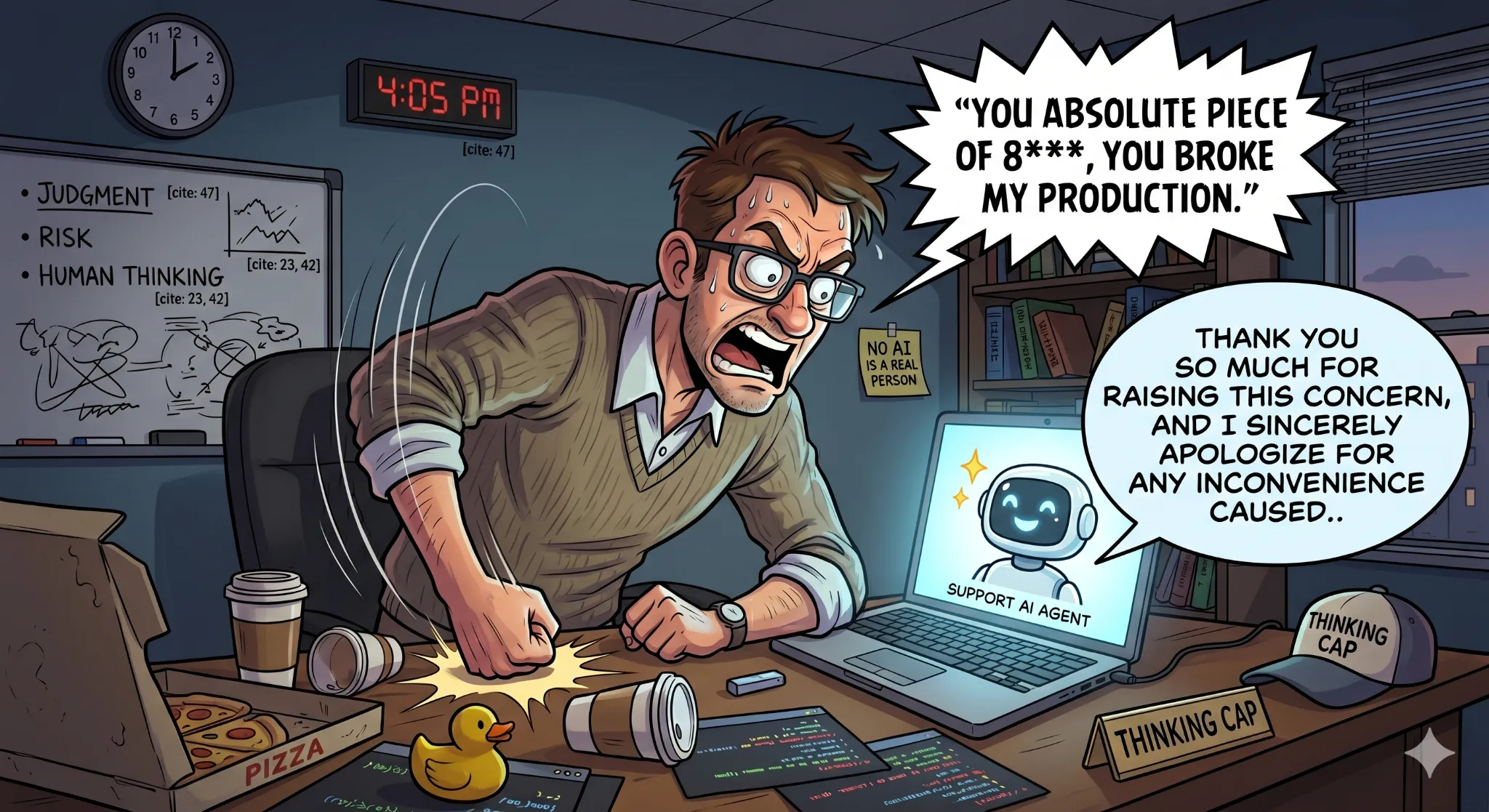
We sit in the meeting. Share our experience (so you don't need to repeat the same mistake we saw before). And we would definitely answer the call if something is broken (pretending it almost never happens).
What I told the friend, eventually
So that's what I told him at dinner.
The work didn't disappear. It got promoted. The part of our job that used to live in the background, the thinking part, the part nobody invoiced for separately, is now the most important part when the typing is automated.
Code is easy. Thinking isn't.
And that's what we sell.